Creative Director: Davide Rampello, Studio Rampello and Partners
Set Design Consultant: Alessandro Camera
Lighting Design Consultant: Lorenzo Bruscaglioni, Luminae Lighting Design
Sound Design Consultant: Alessandro Pasini, P2A Design
Landscape Consultant: Flavio Pollano
Wayfinding Consultant: Luigi Farrauto, 100km studio
Graphic Consultants: studio FM milano
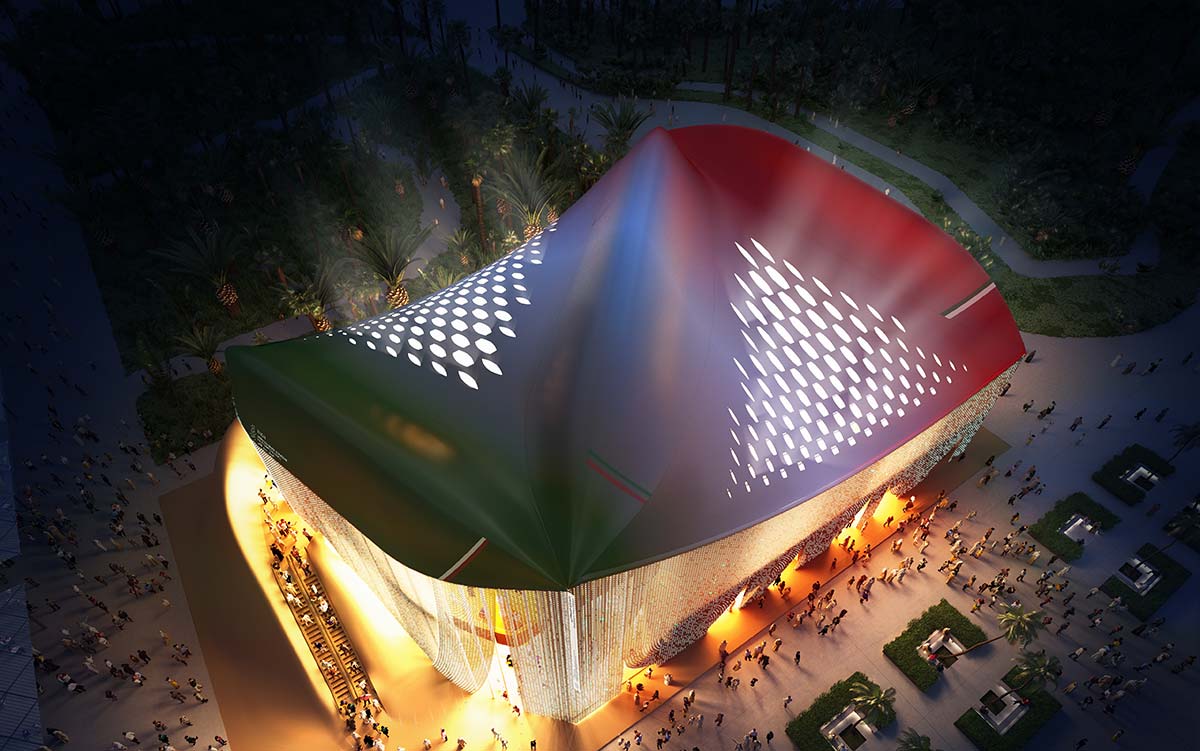
Two incredibly powerful universal symbols, the ship and the roof, are the constituent elements of the project for the Italian Pavilion at Expo 2020, for a theme that is just as universal: beauty, that brings people together, in “Beauty Connects People”. Exactly one year before the opening of Expo Dubai, scheduled for 20 October 2020, the Ministers of Foreign Affairs of the two countries officially presented, in Matera (the 2019 European Capital of Culture), the final project developed by CRA-Carlo Ratti Associati, Italo Rota Building Office, matteogatto&associati, and F&M Ingegneria.

The hulls of three ships in the colours of the Italian flag (green, white, and red), after a metaphoric journey to Dubai, create the visual basis of the approximately 3,500 square meter pavilion, with a digitally reconfigurable height of 27 meters, conceived as an experiment in reuse and circular economy. The structure will be open to the outside and in continual transformation, enveloped in facades made up of LED curtains and nautical ropes, and equipped with a digital covering for the viewing of multimedia content.

“We liked the idea of a pavilion that would continuously mutate into different forms,” says Carlo Ratti, founding partner of CRA, “we pursued a kind of architecture that could be reconfigured both in the long term – because of its circularity – and in the short term – thanks to digital technologies.” As a tribute to the physical geography of the host country, the covering presents undulating lines that reproduce the shape of waves on the sea and sand dunes in the desert, and real sand will be used for the giant sand dune that will make up the base of the pavilion.


In keeping with the concept of sustainable construction, natural strategies for climate control and integrated organic or recovered materials will be used, such as mycelium, recycled plastic extracted from oceans, orange peels, and coffee grounds (these last used in the production of materials for the cladding of the skywalk pathway).
According to Davide Rampello, creative director of the project, “The three words in the title are the synthesis of the narrative that we want to bring to the Italy Pavilion. Starting with the meaning of ‘Beauty’, intended as a sentiment and not as an aesthetic quality, we decided to begin with the story of our country, a story that is full of emotions. ‘Connection’ is the theme of the Expo, ‘Connecting Minds’, and is at the foundation of our values and our identity. ‘People’: Italians will be the true protagonists, their outstanding stories of innovation, creativity, and design.”

Inside, the pavilion’s expository journey is conceived as a gaze that begins with a panoramic view and then accompanies visitors in an exploration of narrative architecture: from the Belvedere (an octagonal window onto Italy’s most evocative landscapes), through the Short Stories (a space dedicated to short expository and cinematographic stories on the outstanding products of Italian know-how) and the Osservatorio dell’Innovazione (an immersive area that focuses on the latest frontiers of Italian space and waters research curated by Milan’s Polytechnic University), all the way to the Teatro della Memoria (dedicated to the mother of all muses). Through galleries of Byzantine-inspired mosaics, the journey ends with a look at the sculpture which, more than anything else, is a metaphor for the excellence of Italian art and culture in the world: a life-size copy of Michelangelo’s David will be positioned within a wooden structure inspired by renaissance theatres. The technical partners and sponsors of the Pavilion, situated in the ‘cultural spine’ of the Expo, will be Fincantieri, Gruppo Boero, Eni, Leonardo, Enel X, Gruppo Mapei, and Tolo Green.